Portal | Wildflowers Home Page | Plant Books | 500+ Flower Photos | Edibles | Weed Ecology | Mushrooms | Links

Parsley or Carrot Family
(also known as the Umbel Family: Umbelliferae)

Key Words: Compound umbels. Usually hollow flower stalks

The Parsley Family includes some wonderful edible plants like the carrot and parsnip, plus more aromatic spices found in your spice cabinet, such as anise, celery, chervil, coriander, caraway, cumin, dill, fennel and of course, parsley. But unlike the Mustard or Mint families, the Parsleys are not all safe for picking and eating. In fact, the Parsley family is among the most important families of plants to learn, since it includes the deadliest plants in North America: poison hemlock and water hemlock. Note that the hemlock tree is totally unrelated.

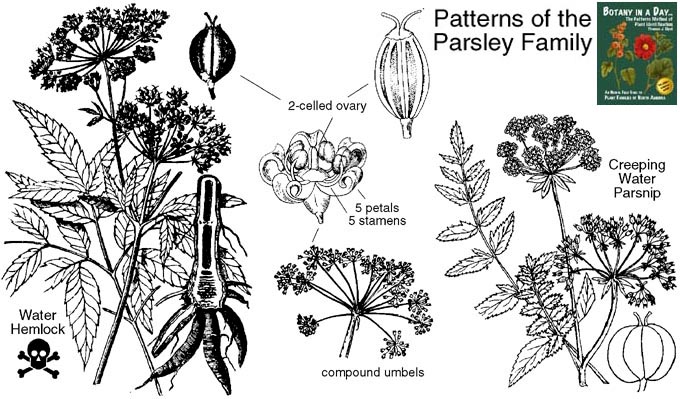
For identification, the most distinctive pattern of the Parsley family is the "compound umbels". Notice how all the stems of the flower cluster radiate from a single point at the end of the stalk, kind of like an umbrella. At the end of each of these flower stems there is another umbrella of even smaller stems, hence the "compound umbrella" or "compound umbel". To be a true umbel, the stems or spokes must all radiate from exactly the same point. Other flowers like the common yarrow may appear to have compound umbels, but look closer and you will see that the flower stems are staggered off the main stalk, so the yarrow is not a member of this family. Another pattern of the Parsley family is that the stems are usually, but not always hollow. Kids have been poisoned using hemlock stems for straws.

When you recognize the compound umbels of the Parsley family then you know you have to be careful. You must be 100% certain of what these plants are before you harvest them for food or medicine. More than that, you must be right! People die just about every year thinking they have discovered some kind of wild carrot.

So how do you distinguish the poisonous members of the family? Don't rush it. You might think that learning plants is just a matter of filling up the disk space in your head with data, but there is a bit more to it than that. No matter what you study, whether it is plant identification, art, or math, you learn by connecting neurons in the brain to build a neural network for processing the information. Getting started is the most dangerous time, because all the plants tend to look alike-- kind of green mostly. Just practice pointing out compound umbels everywhere you go, starting with the dill or fennel in the garden. The more you practice this and other family patterns, the more you will learn to see just how unique and different each plant is.

When you are proficient at recognizing the major plant families, then go back and start studying more of the individual plants. Even then, avoid rushing to conclusions. Keep in mind that when your goal is to find an answer, then you will find one, whether it is right or not.

If you are positive that you have identified a member of the Parsley family correctly, that's good. Now wait and see if you are still sure of your answer in a few days or a week. When you get good at recognizing certain species every time you see them, then you might consider trying out their appropriate edible or medicinal uses. Worldwide there are about 300 genera in the Parsley family, representing more than 3000 species. About 75 genera are native to North America.


Plants of the Parsley Family
Notice the compound umbels in each of the flowers below.

Angelica arguta. Lyall's Angelica. Yellowstone National Park.

Angelica arguta. Lyall's Angelica. Yellowstone National Park.

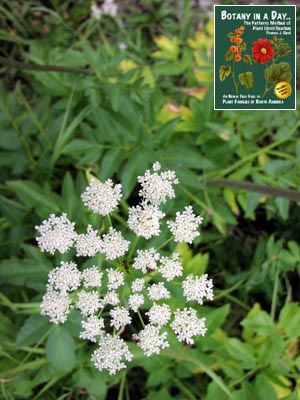
Angelica douglasii.Douglas Angelica. Near Glacier National Park. Montana.

Angelica douglasii. Douglas Angelica. Near Glacier National Park. Montana.

Conium maculatum. Poison Hemlock. Widespread.

Conium maculatum. Poison Hemlock. Widespread.

Cicuta douglasii. Water Hemlock. Widespread. The deadliest plant in North America.

Cicuta douglasii. Water Hemlock. Widespread. The deadliest plant in North America.

Cicuta douglasii. Water Hemlock. Widespread. The deadliest plant in North America.


Botany in a Day

Daucus carota.Wild Carrot. The wild carrot is the same species, but a different variety than the carrots we grow and eat. The plant was introduced from Eurasia and is now widespread across North America, but mostly uncommon in Montana.


Botany in a Day

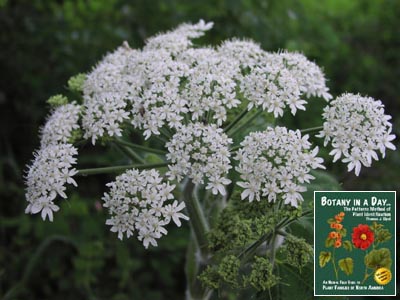
Heracleum maximum. Cow Parsnip. Tobacco Root Mountains near Pony, Montana.

Heracleum maximum. Cow Parsnip. Tobacco Root Mountains near Pony, Montana.

Osmorhiza occidentalis. Sweet Cicely. Tobacco Root Mountains near Pony, Montana.

Osmorhiza berteroi. Mountain Sweet Cicely. Tobacco Root Mountains near Pony, Montana.

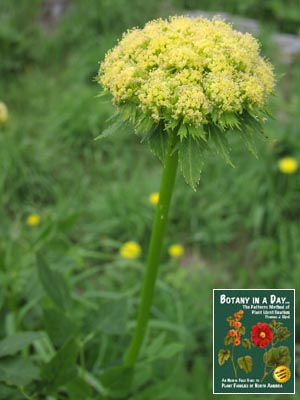
Lomatium triternatum. Nine Leaf Biscuitroot. Tobacco Root Mountains near Pony, Montana.

Lomatium triternatum. Nine Leaf Biscuitroot. Tobacco Root Mountains near Pony, Montana.

Lomatium dissectum. Fern-leaf Biscuitroot. Tobacco Root Mountains near Pony, Montana.

Lomatium dissectum. Fern-leaf Biscuitroot. Tobacco Root Mountains near Pony, Montana.

Lomatium dissectum. Fern-leaf Biscuitroot. Tobacco Root Mountains near Pony, Montana.

Lomatium cous. Biscuitroot. Ruby Range. Near Alder, Montana.


Botany in a Day

Perideridia gairdneri. Yampa. Tobacco Root Mountains near Pony, Montana.

-Also see these West Coast members of the Parsley Family-

  • Angelica hendersonii Pacific Angelica. Photographed along the Oregon coast.
  • Foeniculum vulgare Sweet Fennel (whole plant). Native to the Mediterranean coastal areas, but widely naturalized in the U.S. Photographed in California.
  • Foeniculum vulgare Sweet Fennel (flowers). Native to the Mediterranean coastal areas, but widely naturalized in the U.S. Photographed in California.

There are more
Parsley Family pictures
at the Texas A&M Biometrics Experimental Database.

-Learning Plants by Families Article-
Go to Page 4: The Pea Family
Return to Introduction


Check out Botany in a Day

Return to the Plant Families Index

Return to the Wildflowers & Weeds Home Page


PO Box 684
Silver Star, MT 59751
406-287-3605
E-mail Contact Page

How to Place Retail Orders

     Order On-Line: Order on-line with your Visa, Mastercard, Discover or American Express. Simply click on the links to learn more about each product and enter the quantity you want in the little white boxes, then click the "Add to Order" button. You will be transferred to our secure payment service for the final check-out.

      Order by mail or telephone: We accept checks and money orders payable in US dollars. Please use the on-line shopping basket to tally your order. Click the "Pay for Order On-line" button to calculate the postage, then print or copy the information and call or send it to us at the address above.

Shipping Options
USA Customers
We ship all USA orders via USPS Priority Mail, except as otherwise noted on the website. Express Mail shipping is available by special request.

International
Customers outside the USA
please click here for additional
shipping information.


Granny's Country Store Departments
Tom's Books & Videos
Wilderness Survival | Nature, Wildlife, Tracking
Wildflowers and Edibles | Resources for Educators
Home-Building Resources | Goods for Green Living
Books & Gifts for Kids

Thomas J. Elpel's Web World Pages
Green University | Granny's Country Store | HOPS Press, LLC
Sustainable Living Skills | Primitive Living Skills
Wildflowers & Weeds | Society of Primitive Technology
Jefferson River Canoe Trail | What's New? | Search This Site!

Return to Thomas J. Elpel's
Web World Portal | Web World Tunnel

© 1997 - 2008 Thomas J. Elpel