|
Fabaceae
Plants of the Pea Family
(Previously known as the Legume Family: Leguminosae)
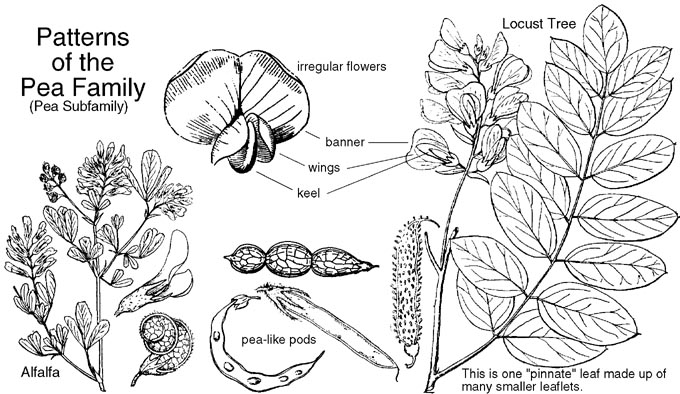
If you have seen a pea or bean blossom in the garden, then you will be able to recognize members of the Pea family. These are irregular flowers, with 5 petals forming a distinctive "banner, wings, and keel", as shown in the illustration. The banner is a single petal with two lobes though it looks like two that are fused together. Two more petals form the wings. The remaining two petals make up the keel and are usually fused together. The proportions of the parts may vary from one species to another, but as long as there is clearly a banner, wings and keel, then the plant is a member of the Pea family. Pea-like pods are another distinctive trait of the family.
For practice, look at a head of clover in the lawn. You will see that each head is a cluster of many small Pea flowers, each with its own banner, wings, and keel. As the flowers mature each one forms a tiny pea-like pod. I'll bet you never noticed that before!
The Pea family is very large, with 600 genera and 13,000 species worldwide, all descendents of the very first Pea flower of many millions of years ago. Over time the Peas have adapted to fit many different niches, from lowly clovers on the ground to stately trees that today shade city sidewalks. Families this large often have subgroupings called subfamilies and tribes. It works like this:
The most closely related species are lumped together into a single group or "genus". For example, there are about 300 species of clover in the world. Each one is clearly unique, but each one is also a clover, so they are all lumped together as one genus, Trifolium (meaning 3-parted leaves) and given separate species names such as T. arvense or T. pratense, etc.
If you compare clovers to other members of the Pea family then you will see that they share more in common with alfalfa and sweet clover than with other plants like beans or caragana bushes. Therefore the clover-like plants are lumped together as the Clover tribe while the bean-like plants are lumped together as the Bean tribe, and so forth, for a total of eight tribes. Each of these tribes share the distinctive banner, wings and keel, so they are all lumped together as the Pea subfamily of the Pea family. All Peas across the northern latitudes belong to this group.
As you move south you will encounter more species of the Pea subfamily, plus other plants from the Mimosa and Bird-of-Paradise-Tree or Senna Subfamilies. These groups include mostly trees and shrubs, but also a few herbs. Their flowers do not have the banner, wings, and keel, however most have pinnate leaves, much like the one in the illustration, plus the distinctive pea-like pods that open along two seams. Each subfamily is distinct enough to arguably qualify as a family in its own right, but they still share enough pattern of similarity between them to lump them together as subcategories of a single family.
Overall, the plants of the Pea family range from being barely edible to barely poisonous. Some species do contain toxic alkaloids, especially in the seed coats. Many people are familiar with the story of Christopher McCandless who trekked into the Alaska wilderness in 1992 and was found dead four months later. He had been eating the roots of Hedysarum alpinum, and assumed the seeds were edible too, so he gathered and ate a large quantity of them over a two-week period. The seeds, however, contained the same toxic alkaloid found in locoweed, which inhibits an enzyme necessary for metabolism in mammals. It is now believed that McCandless was still eating, but starved to death because his body was unable to utilize the food. Even the common garden pea can lead to depression and nervous disorders with excess consumption. So it is possible to poison yourself with members of this family, but it takes some effort.
Key Words: "Banner, wings, and keel". Pea-like pods, often with pinnate leaves.
Pea Family / Pea Subfamily
Try to identify the banner, wings and keel in each of the pictures below.
Broom Tribe | Golden Pea Tribe | Hedysarum Tribe | Licorice Tribe | Clover Tribe | Trefoil Tribe | Pea Tribe |
Mimosa Subfamily | Caesalpinia (Bird-of-Paradise Tree) Subfamily
Please e-mail Thomas J. Elpel to report mistakes or to inquire about purchasing high resolution photos of these plants.
Pea Subfamily
Broom Tribe
 Lupinus arbustus. Longspur Lupine. Near Craters of the Moon National Monument, Idaho. |  Lupinus arbustus. Longspur Lupine. |
 Lupinus pusillus. Rusty Lupine. |  Lupinus pusillus. Rusty Lupine. Tongue River, Montana. |
 Lupinus sp. Lupine. Arizona. |  Lupinus arboreus. Tree lupine, also known as yellow bush lupine, is native to California. It has escaped cultivation to become naturalized in western Europe, New Zealand, Australia, parts of southern South America and the Falkland Islands. |

Large leaf lupine: Lupinus polyphyllus. |

Large leaf lupine: Lupinus polyphyllus. Large leaf lupine is native to the West Coast of North America, this one photographed as an introduced plant in Sweden. |
 Cytisus scoparius. Scotch Broom. Introduced. Photographed in Idaho. |
 Cytisus scoparius. Scotch broom is native to Europe. It has been intentionally or accidentally spread around the world, often becoming a serious problem. It has become an invasive species in the Pacific Coast of North America as well as in New Zeealand, Australia, and India. |
 Ulex europaeus. Gorse is native to Europe. It has been intentionally or accidentally spread around the world, often becoming a serious problem. In New Zealand">New Zealand, gorse was introduced for use as a hedge, but turned into an invasive plant, overtaking pastures with its coarse and spiny vegetation. Gorse has also become a problem plant in the western United States and Chile. |

Foraging the Mountain West |
Pea Subfamily
Golden Pea Tribe
 Thermopsis montana. Golden Pea. |  Thermopsis montana. Golden Pea. Pony, Montana. |
Pea Subfamily
Hedysarum Tribe
 Onobrychis viciifolia. Sainfoin. |
 Onobrychis viciifolia. Sainfoin. Introduced as a forage plant. |
Pea Subfamily
Licorice Tribe
 Oxytropis lambertii. Purple Locoweed. |  Oxytropis lambertii. Purple Locoweed. Tongue River, Montana. |
 Astragalus atropubescens. Purple Milkvetch. |  Astragalus atropubescens. Purple Milkvetch. Pony, Montana |
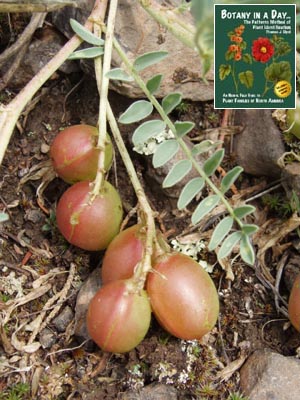 Astragalus succulentus. Ground Plum. |  Astragalus succulentus. Ground Plum. |
 Astragalus whitneyi. (?) Balloon Pod Milkvetch. |  Astragalus whitneyi. (?) Balloon Pod Milkvetch. |
 Astragalus sp. Milkvetch. Pony, Montana. |  Caragana arborescens. Caragana. Cultivated. |
 Glycyrrhiza lepidota. Wild Licorice. Common across the west. This one was photographed near Rexburg, Idaho. |  Dalea purpurea. Prairie Clover. Castle Mountains, near the Smith River in Montana. |
 Dalea formosa. Feather Dalea. |  Dalea formosa. Feather Dalea. Fort Bowie National Historic Monument, Arizona. |
 Dalea versicolor. Indigo Bush. Arizona. |
Botany in a Day |
 Pediomelum esculentum. Indian Breadroot. |  Pediomelum esculentum. Indian Breadroot. Also known as Psoralea esculenta . |
Pea Subfamily
Clover Tribe
 Trifolium repens. White clover. |  Trifolium repens. White clover. |
 Trifolium haydenii. Bigleaf Clover. |  Trifolium haydenii. Bigleaf Clover. Bridger Mountains. Near Bozeman, Montana. |
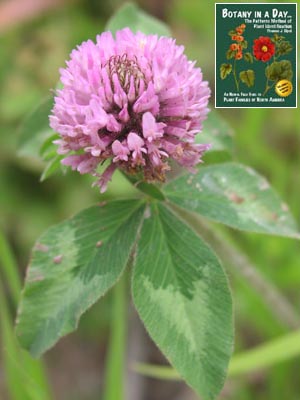 Trifolium pratense. Red Clover. |
 Trifolium wormskiodii. Springbank Clover. Photographed along the California-Oregon coast |
 Medicago sativa. Alfalfa. Introduced and cultivated for livestock forage and hay. |
 Melilotus officinalis. Yellow Sweet Clover. Escaped from cultivation. |
Pea Subfamily
Trefoil Tribe
 Lotus corniculatus. Bird's Foot Trefoil. |
 Lotus corniculatus. Bird's Foot Trefoil. |
 Lotus corniculatus. Bird's Foot Trefoil. |
 Lotus sp. Lotus. Fort Bowie National Historic Monument. Arizona. |
Pea Subfamily
Pea Tribe

Hairy Vetch: Vicia villosa. |

Hairy Vetch: Vicia villosa. |
Pea Family
Mimosa Subfamily
 Calliandra sp. Fairy Duster. |  Calliandra sp. Fairy Duster. Near Portal, Arizona. |
 Prosopis pubescens. Screw Bean Mesquite. |
Botany in a Day |
Pea Family
Caesalpinia (Bird-of-Paradise Tree) Subfamily
(Unrelated to the Bird-of-Paradise Plant)
 Cercis occidentalis. Western Redbud. |  Cercis occidentalis. Western Redbud. Photographed in California. |
 Cercidium microphyllum. Palo Verde Tree. |  Cercidium microphyllum. Palo Verde Tree. Arizona. |
 Parkinsonia florida. Blue Palo Verde. Arizona. |
Botany in a Day |
There are more
Pea Family pictures
at PlantSystematics.org.
Return to the Plant Families Index
Return to the Wildflowers & Weeds Home Page
|


 Wildflowers-and-Weeds.com