|

Lamiaceae
Plants of the Mint Family
(also known as Labiatae)
If you pick a plant with a distinctly square stalk and simple, opposite leaves, then it is very likely a member of the Mint family. Be sure to smell it too, since many species of the family are loaded with aromatic volatile oils.
The rich, spicy quality of these plants makes them useful in cooking, and nearly half the spices in your kitchen come from this one family, including basil, rosemary, lavender, marjoram, germander, thyme, savory, horehound, plus culinary sage (but not sagebrush!), and of course mint, peppermint, and spearmint.
For the beginning botanist, that is all you really need to remember: "square stalks with opposite leaves, and usually aromatic". Worldwide there are about 180 genera in the Mint Family representing some 3500 species. Approximately 50 genera are found in North America.
Medicinally this family is rich in volatile oils, especially menthol, often used as the penetrating vapors in cough drops. These spicy oils are stimulating and warming, causing the body to open up and sweat; so most of these plants are listed as diaphoretic in herbal books. This property can help you break a fever. A fever is the body's way of "cooking" the microorganisms that cause infections. Using a diaphoretic herb can help raise a mild fever just high enough to "cook" a virus, thus "breaking" or ending the fever.
Volatile oils are also highly lethal to microorganisms. On camping trips I often use aromatic Mints to help purify questionable water. Eating a few Mint leaves after drinking from a creek certainly won't kill everything in the water, but it sure helps.
You can safely sample any member of the Mint family. Some species like the Coleus, a house plant with red and green leaves, have no aroma at all, while a patch of the more potent Agastache may bring tears to your eyes just passing through.
Note that there are a handful of other plants with square stems and opposite leaves, which may be confused with the Mints. Those plants are found in the Loosestrife, Verbena and Stinging Nettle families, but none of them smell minty.
As you become proficient at identifying members of the Mint family by their square stalks, opposite leaves, and spicy aroma, you should also familiarize yourself with the flowers.
Notice in the illustration that there are 5 sepals, all fused together so that only the tips are separate. The 5 petals are also fused together, but note how asymmetrical or "irregular" the flowers are, compared to the more symmetrical or "regular" Mustard flowers. Some Mint flowers are much more irregular than others, but if you study them closely you will see that they typically have 2 petal lobes up and 3 petal lobes down. Inside the flower there are 4 stamens, with one pair longer than the other. As you learn these patterns of the Mint family you will be able to recognize and use them anywhere in the world.
Key Words: Square stalks and opposite leaves, often aromatic.
Please e-mail Thomas J. Elpel to report mistakes or to inquire about purchasing high resolution photos of these plants.
 Agastache urticifolia. Giant hyssop. | 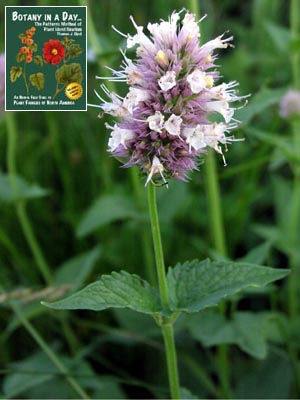 Agastache urticifolia. Giant hyssop flowers. |
 Agastache urticifolia. Giant hyssop (after the petals have fallen). Pony, Montana. |
 Lycopus asper. Rough Bugleweed. Yellowstone National Park. |
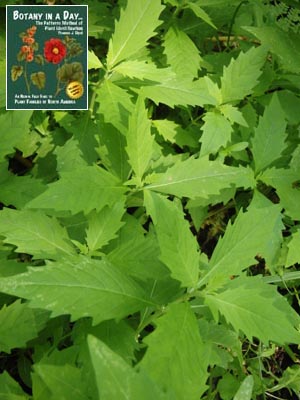 Lycopus uniflorus. Northern Bugleweed. Photographed near Kettle Falls, Washington. |
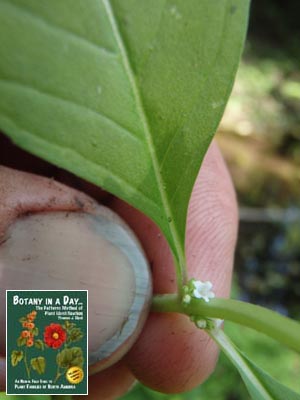 Lycopus uniflorus. Northern Bugleweed. |
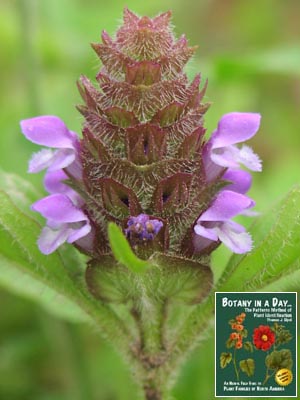 Prunella vulgaris. Self Heal. |  Prunella vulgaris. Self Heal. |
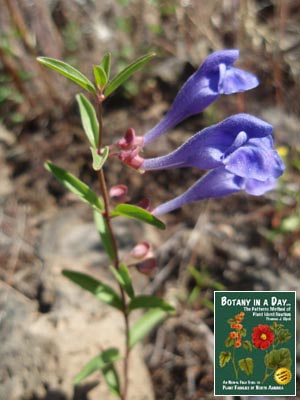 Scutellaria antirrhinoides. Skullcap. | 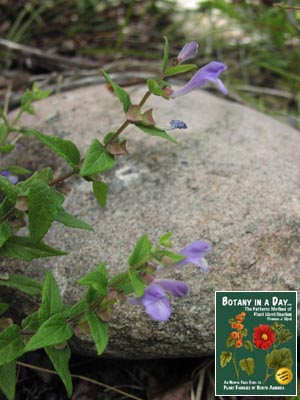 Scutellaria galericulata. Skullcap. Near Virginia City, Montana. |
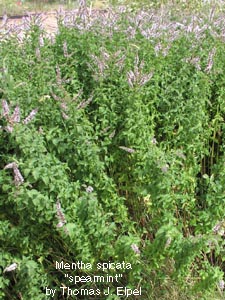 Mentha spicata. Spearmint. |  Mentha spicata. Spearmint. Spearmint is not native to North America, but it often escapes cultivation. |
 Mentha arvensis. Field Mint. | 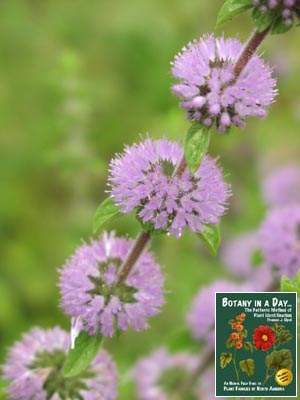 Mentha arvensis. Field Mint. Photographed along the northern California coast. The same species is found in Montana and the Rocky Mountains, but varies in appearance. |
 Marrubium vulgare. Horehound. Horehound is not native to North America, but it often escapes cultivation. | 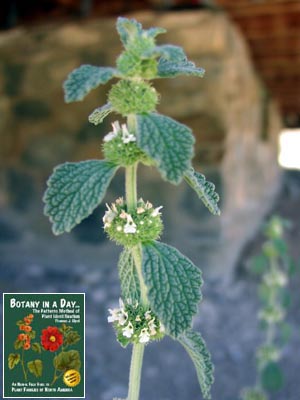 Marrubium vulgare. Horehound. Fort Bowie National Historic Monument. Arizona. |
 Monarda fistulosa. Horsemint or Wild Bergamont. |  Monarda fistulosa. Horsemint or Wild Bergamont. |
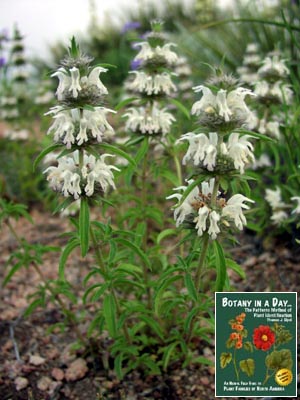 Monarda sp. White Bee Balm. |  Monarda sp. White Bee Balm. Chatfield State Park. Denver, Colorado. |
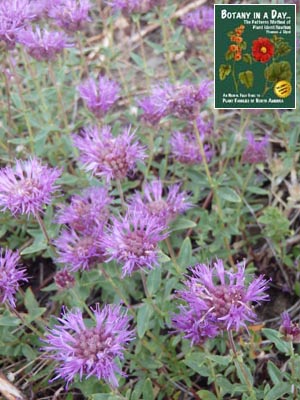 Monardella odoratissima. Mountain Coyote Mint. This mint has the most amazing smell! |
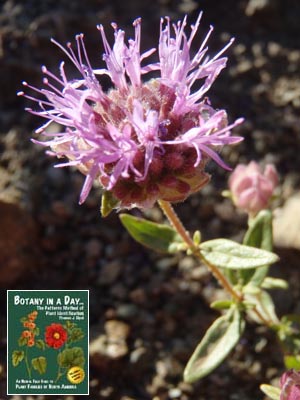 Monardella odoratissima. Mountain Coyote Mint. Photographed in the Seven Devils Mountains of Idaho. |
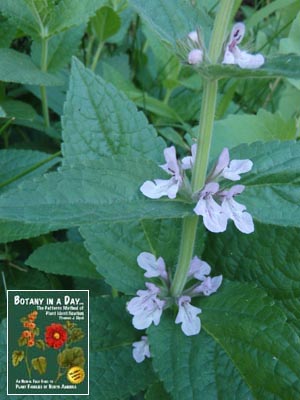 Stachys palustris. Hedge Nettle. Photographed in Hells Canyon, Idaho. |  Stachys palustris. Hedge Nettle. Photographed along the Jefferson River in southwest Montana. |
 Salvia columbaraie. Chia. |  Salvia columbaraie. Chia. Fort Bowie National Historic Monument. Arizona. |
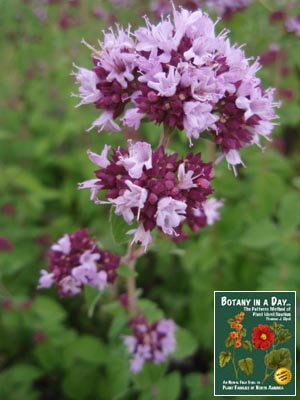 Origanum vulgare. Oregano. Cultivated. |
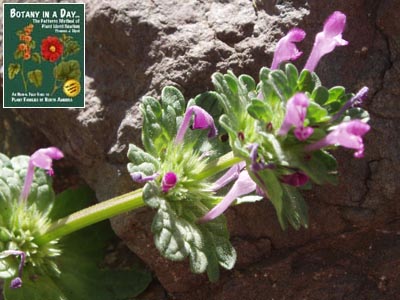 Lamium amplexicaule. Henbit Dead-nettle. |

Foraging the Mountain West |
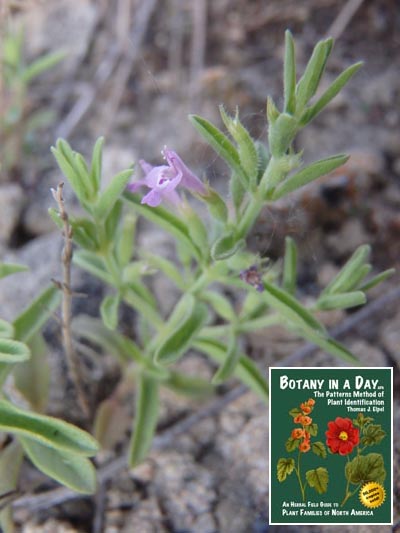 Hedeoma drummondii. Drummond's false pennyroyal. Tongue River, Montana. |

Common Hemp-Nettle: Galeopsis tetrahit. |
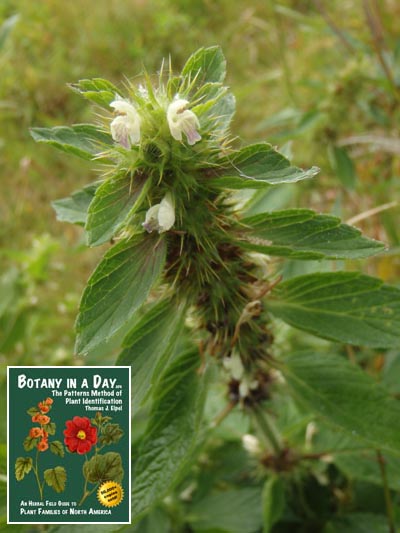
Common Hemp-Nettle: Galeopsis tetrahit. Photographed in Sweden. |

Motherwort: Leonurus cardiaca. |
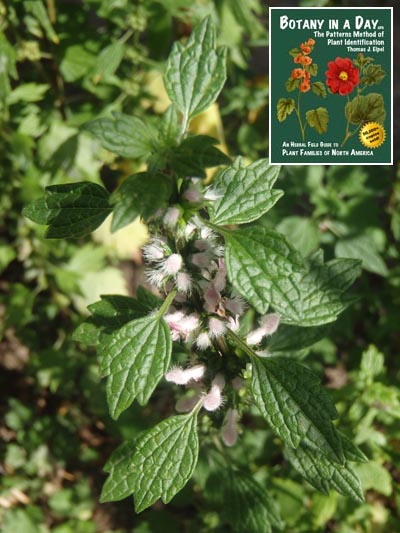
Motherwort: Leonurus cardiaca. Photographed in Sweden. |
There are more
Mint Family pictures
at PlantSystematics.org.
Return to the Plant Families Index
Return to the Wildflowers & Weeds Home Page
|


 Wildflowers-and-Weeds.com