Musk Thistle or Nodding Thistle
(Carduus nutans)
Aster Family / Thistle Subfamily
By Thomas J. Elpel with additions by Pamela G. Sherman

About the Musk Thistle: Also called Nodding thistle, it's found up to 9,000 feet in elevation and can grow up to 8 feet tall. A biennial, musk thistle is taprooted and reproduces by seed. With one purplish flowering head per stem, the outer broad, stout phyllaries (Aster family bracts) spreading and bent downward, the whole set of them high and hairy. The thick leaves are somewhat lobed with wavy, white-outlined margins and big, light-green mid-veins. Basal leaves are bigger than leaves farther up the stout stem. All the leaves are long and decurrent (leaves that continue down the stem beyond the point of attachment).
The musk thistle is native to southern Europe and western Asia. It was introduced to this continent early in the 1900's, and now it is widespread across the U.S. and Canada. Musk thistle thrives in areas where livestock have lingered, especially bedding areas where stock return to the same spot each day through the growing season. The musk thistle is a biennial, meaning that the plants form a rosette on the ground the first year, then send up a flower stalk and die the second year. Hummingbirds thrive on the nectar of the flowers.
 Edible/Medicinal Thistles are quite edible, except for the spines. Livestock often eat thistles after the plants are cut, apparently since they can bite into them without getting poked in the nose. Wilting may also make the plants easier to ingest without injury.
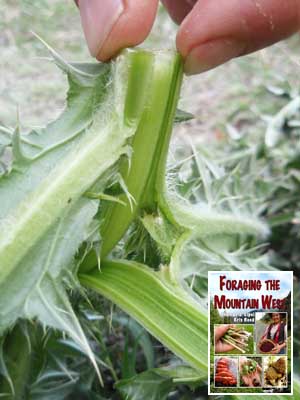
The musk thistle is an edible wild food for people too, provided it hasn't been sprayed. It is one of my favorite snacks. There is a technique to peeling the stalk while avoiding the stickers. Thistles are only good when the stalks are still fleshy; as summer progresses they become woody and inedible. Carefully grasp the tip of a budding flower and bend the stalk over to see how much of the plant is still succulent and where it has already become woody. With a quick slice of a knife, cut through the stalk taking only the top succulent part.
 Do not cut all the way through the stalk, but rather, leave the "rind" intact on one side and let the thistle top hang down from that rind. Carefully grab the thistle top and pull it gently away from the parent stalk. This action peels the rind off the side of the stem that is still attached to the main stalk. The peeled side of the stem provides a safe, stickerless place for your fingers. The rest of the process is like peeling a banana. Start at the cut and peel the spiny rind off on each side of the stem. I think you will agree that thistle stalks are delicious! See Foraging the Mountain West for more details.
Some also make a green thistle drink by juicing and straining young thistle leaves. Katrina Blair of Durango makes a thistle root chai and other dishes from musk thistle and enjoys chewing the purple flower as chewing gum.
Medicinally, musk thistle leaves and seeds are useful as a bitter tonic to stimulate liver function. Studies in India have documented that the seeds contain a linoleic acid-rich oil rich which has proved useful in the prevention of atherosclerosis. According to ethnobotanist Dr. James Duke, this thistle has been used as a detoxifying herb and to lower fever.
Bees and goldfinches love it. Its fiber can be used to make paper and the down used as tinder for the woodstove or campfire. Without the seedhead it can be composted.
Mechanical Controls: It may be possible to control the musk thistle by cutting the plants, since they only live for two years. Timing is essential though, because if the flower stalks are cut too soon then they will produce new flowers. Wait until the flowers just begin to open, then cut the stalk as close to the ground as possible. They can also be dug up, roots and all, bagged, and removed from site (or cut up and composted without the seedhead).
Biological Controls:The musk thistle weevil (Trichosirocalus horridus) was introduced as a biological control to feed on the seeds of the this thistle, limiting its spread. Inspect thistle heads in your area for signs of the weevil. If the weevil is not present then contact your county weed board for assistance. Kathy Voth trains cows to eat weeds, including thistles. Sheep, goats, horses, donkeys, and llamas will also eat thistle flowers.
Chemical controls: For spot applications try glufonsinate-ammonium (Finale®) early in the season or glyphosate (Roundup®) later in the season. These are non-selective herbicides, so care should be taken to avoid hitting non-target plants.
Large infestations of musk thistle require selective herbicides, but 2,4-D is only minimally effective by itself. Clopyralid (Transline®) or a blend of clopyralid and 2,4-D (Curtail®) is more effective. Metsulfuron (Escort®), picloram (Tordon® 22K), or chlorsulfuron (Telar®) are also effective. The herbicides should be applied in the spring after seedlings and rosettes have emerged, but before the flower stem matures.
Important: Most "weed problems" are really "people problems" from poor land management and a lack of ecological insight. It is easy to reach for a tool like fire, mowing, or herbicides to attack an out-of-control weed, but often those tools do little to get to the root cause of the weed infestation, and sometimes make the problems worse. Please read more about range ecology, desertification, and invasive weeds on this website before applying any tool of weed control Go to: Desertification and Invasive Weeds.
Notes
- Thomas J. Elpel. Participating in Nature, 5th Edition. HOPS Press: Pony, MT. November 2002.
- Thomas J. Elpel. Botany in a Day, 5th Edition. HOPS Press: Pony, MT. January 2004.
- William A. Weber and Ronald C. Wittmann. Colorado Flora: Eastern Slope. University Press of Colorado. Third Edition 2001 p. 80.
- Larimer County Weed District. Thistles of Colorado: Identification and Management Guide. Produced by the Larimer County Weed District. 2nd Edition
- Katrina Blair. The Wild Wisdom of Weeds: 13 Essential Plants for Human Survival. Chelsea Green Publishing. White River Junction, VT 2014.
Return to the Weed Profiles Table of Contents


 Wildflowers-and-Weeds.com